Hydroxychloroquine screening
Plaquenil Eye Exam in Pasco, Sunnyside & Hermiston
Yearly retinal screening for people taking Plaquenil for lupus, rheumatoid arthritis and other conditions. Results go straight to your prescribing doctor.
Call any office to book your Plaquenil exam
Plaquenil protects your joints.
This exam protects your vision.
Hydroxychloroquine, sold as Plaquenil, is safe for most people for years. But after long use it can quietly damage the retina, the light-sensing layer at the back of the eye. Early damage causes no symptoms, and severe damage can keep getting worse even after the medication stops.
When changes are caught while they are still mild and the medication is adjusted, they are unlikely to progress. That is the whole point of screening.
When to get checked.
Based on the American Academy of Ophthalmology's 2025 screening guidelines.
-
1
Baseline exam
Soon after you start Plaquenil. It rules out eye conditions you already have and gives us pictures to compare against later.
-
2
Years 1 to 5
If you have no risk factors, yearly screening can usually wait until you reach five years on the medication.
-
3
Every year after
Once a year from year five on, or every year from the start if you have a risk factor.
You need yearly exams from the start if you have:
- A daily dose above 5 mg per kilogram of your actual body weight
- Kidney disease
- Taking tamoxifen at the same time
- Starting Plaquenil at an older age
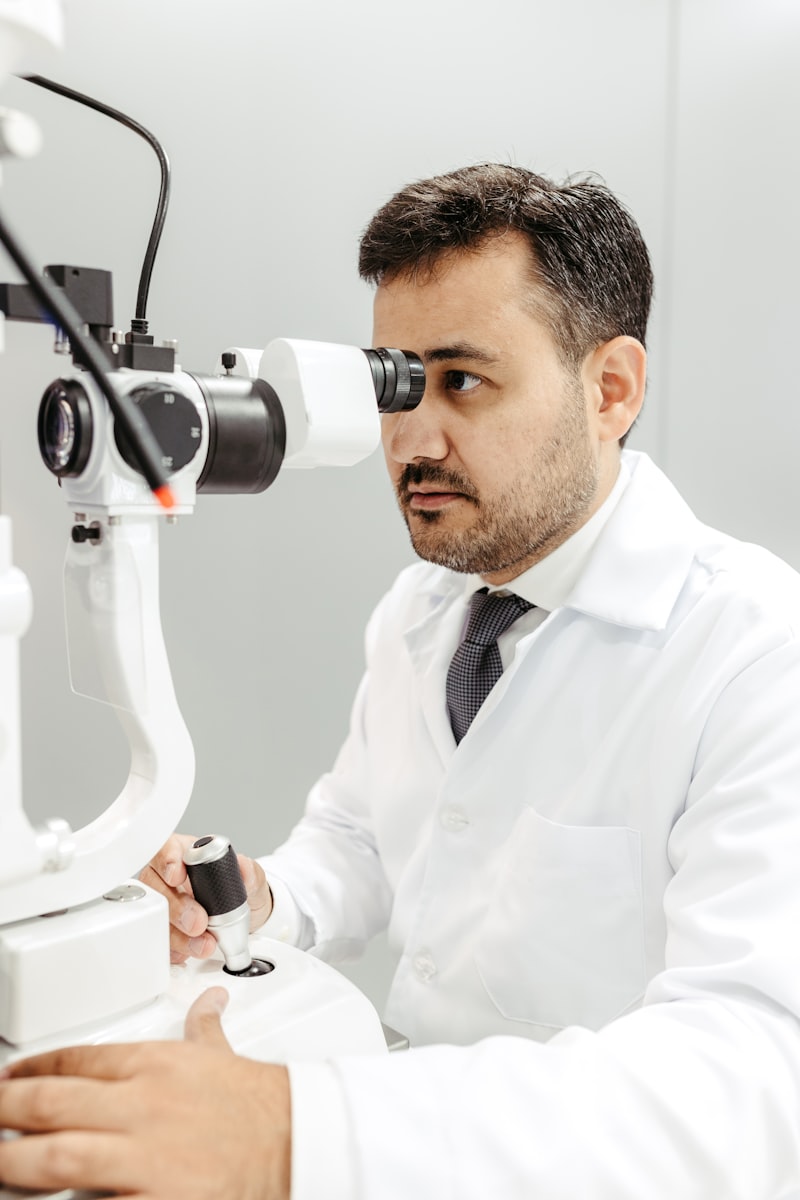
What the exam includes.
- OCT retinal scan
- A quick, painless scan that shows the layers of your retina in fine detail. It is the main screening test in the current guidelines.
- Optomap autofluorescence (FAF)
- A widefield image that shows stress in the retina far beyond the center. Together with OCT, it is what the 2025 guidelines recommend.
- Dilated retinal exam
- Your doctor examines the back of the eye directly. Bring sunglasses for the drive home.
- Visual fields, when needed
- If anything looks unusual, a visual field test helps confirm it. Damage can show up near the center or farther out, so we look for both patterns.
What Plaquenil damage looks like.
Real published cases. The same eyes, years apart: healthy on the left, Plaquenil toxicity on the right. Early changes like these usually cause no symptoms, which is why imaging finds them first.
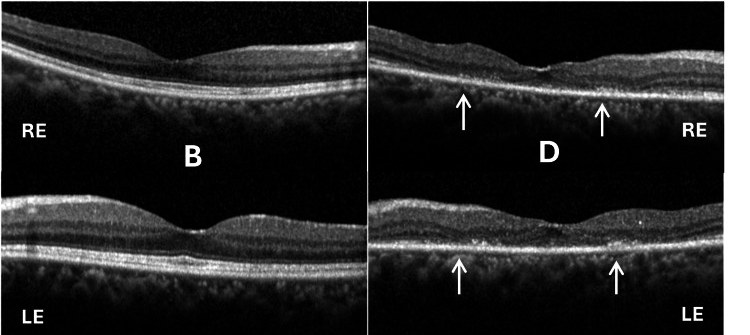
OCT: the retina thins
Each OCT is a cross-section of the retina. On the right, the light-sensing layer has worn away on both sides of the center (arrows), while the very center is spared. This is often the first place damage shows.
Image: Alex et al., Cureus 2025, CC BY 4.0. Cropped.
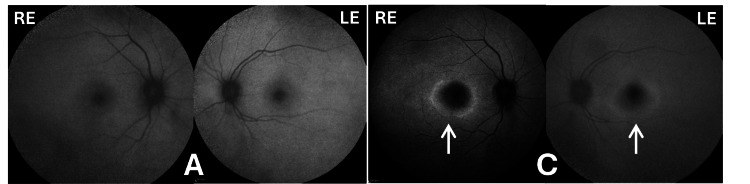
Autofluorescence: a ring appears
Autofluorescence shows stress in the retina as light and dark patterns. On the right, a bright ring has formed around the center (arrows), a classic sign of Plaquenil toxicity. We capture this kind of image on our Optomap.
Image: Alex et al., Cureus 2025, CC BY 4.0. Cropped.
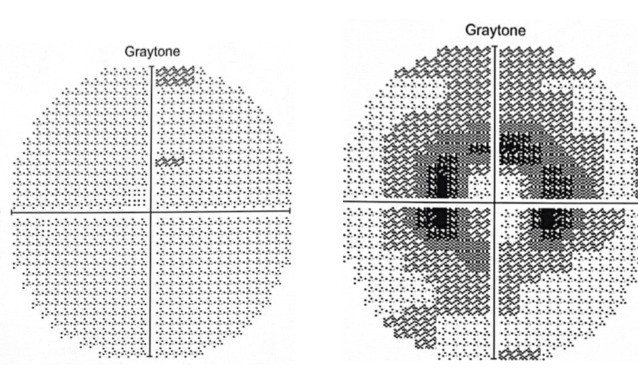
Visual field: blind spots near the center
A visual field test maps what you can see. The darker the area, the less you see there. Over three years this patient developed a ring of missing vision around the center, the kind of change that can make reading harder.
Image: Centner et al., Cureus 2024, CC BY 4.0. Two panels placed side by side.
Results go to your doctor.
We send the findings to whoever prescribes your Plaquenil, whether that is your rheumatologist, dermatologist or primary care provider. Keep taking your medication as prescribed; any change is a decision for you and that doctor.
For referring providersBilled as a medical exam.
Plaquenil screening is usually billed to your medical insurance, including Medicare, rather than a vision plan. Coverage depends on your plan, and our office can help you check before your visit.
Insurance we acceptClose to home, in three towns.
Our Pasco office is a short drive from Kennewick, Richland and West Richland. Sunnyside serves the Yakima Valley, from Grandview to Toppenish, and Hermiston serves Umatilla, Pendleton and Eastern Oregon. No need to drive to Spokane, Yakima or Portland for a yearly screening.
Questions? Answers.
What is a Plaquenil eye exam?
It is a medical eye exam that screens the retina for early damage from hydroxychloroquine (Plaquenil). It centers on the two tests the current guidelines recommend, an OCT scan and widefield autofluorescence imaging, plus a dilated eye exam, with visual field testing when something needs confirming.
Why do I need an eye exam if I take Plaquenil?
Plaquenil is safe for most people for many years, but after long use it can damage the retina in a small number of patients. Early damage has no symptoms, and severe damage can keep getting worse even after the medication is stopped. Screening is how it gets caught early, while it is still mild.
How often do I need a Plaquenil eye exam?
The American Academy of Ophthalmology advises a baseline exam soon after you start, then yearly screening. If you have no risk factors, yearly exams can usually be deferred until you have taken Plaquenil for five years. With a risk factor, screening is yearly from the start.
What are the risk factors for Plaquenil eye damage?
The biggest are dose and how long you have taken it. A daily dose above 5 mg per kilogram of your actual body weight raises the risk. Kidney disease, taking tamoxifen, and starting Plaquenil at an older age also increase it.
How common is Plaquenil retinal toxicity?
At recommended doses it is uncommon early on. In the largest study, patients taking under 5 mg/kg a day had less than a 1% chance of toxicity in the first 5 years and under 2% after 10 years. The risk climbs with longer use and higher doses, which is why yearly screening matters later on.
What tests are done at a Plaquenil eye exam?
The two primary screening tests in the 2025 AAO guidelines: OCT, a scan that shows the layers of the retina in fine detail, and widefield fundus autofluorescence (FAF), which we capture on our Optomap to show stress in the retina well beyond the center. We also do a dilated retinal exam, and visual field testing when anything needs confirming.
Will I notice symptoms of Plaquenil toxicity?
Usually not early on. Most people with early damage have no symptoms, and sharp central vision tends to stay normal until damage is advanced. Some notice small missing spots near the center while reading. That is why screening, not symptoms, is how it is found.
Should I stop taking Plaquenil before my eye exam?
No. Keep taking your medication as prescribed. Decisions about your dose belong to you and the doctor who prescribes it. We send our findings to that doctor so you can decide together.
Do you send results to my rheumatologist?
Yes. We send the findings to your prescribing doctor, whether that is a rheumatologist, dermatologist or primary care provider, so your eye results and your treatment plan stay connected.
Is a Plaquenil eye exam covered by insurance?
It is a medical exam, so it is usually billed to your medical insurance, including Medicare, rather than a vision plan. Coverage depends on your plan, so call the office and we can help you check.
How long does the appointment take?
Plan for extra time compared with a routine exam, because your pupils are usually dilated and the visit includes imaging. Bring sunglasses for the drive home.
Does the same apply to chloroquine?
Chloroquine can affect the retina in the same way and is screened the same way. Let us know which medication and dose you take when you book.
Where can I get a Plaquenil eye exam near Kennewick or Richland?
At our Pasco office, 4820 N Rd 68 inside Walmart, a short drive from Kennewick, Richland and West Richland. We also see patients in Sunnyside for the Yakima Valley and in Hermiston for Eastern Oregon.
Due for your Plaquenil exam?
Call the office closest to you. Tell us your medication and dose when you book.
This page is general health information, not medical advice, and does not create a doctor-patient relationship. Screening timing and tests follow the American Academy of Ophthalmology's Recommendations on Screening for Hydroxychloroquine Retinopathy (2025 Revision); your doctor may recommend a different schedule based on your exam and risk factors. Do not change your medication without talking to your prescribing doctor. Last reviewed October 12, 2026.