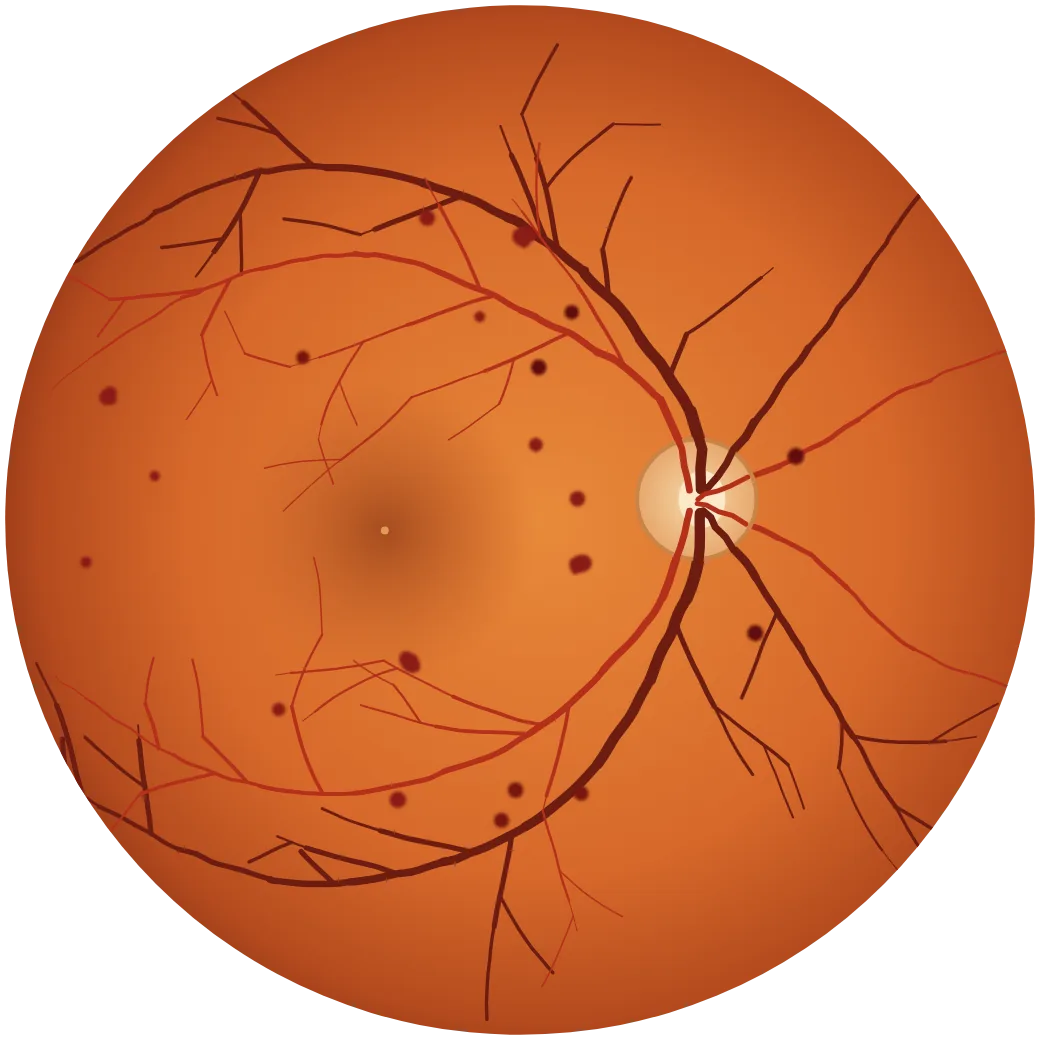
The first diabetic retinopathy symptoms usually arrive late. The National Eye Institute says the early stages often have none. Most people feel fine and see fine while the damage is already under way at the back of the eye, and the only way to find it is to look there.
In a national survey of US adults with diabetes covering 2005 to 2016, about 7 in 10 people who had retinopathy said they didn’t have it. November is National Diabetes Month, so here is what happens before symptoms start, which changes deserve a same-day call, and how often the retina needs a look.
What is diabetic retinopathy?
The retina is the thin layer at the back of your eye that turns light into the signals your brain reads as sight. It runs on a web of very small blood vessels. Over time, high blood sugar damages those vessels. They can swell, leak, bleed or close off.
It’s the most common cause of vision loss for people with diabetes. A 2023 study estimated that 9.6 million people in the US were living with it in 2021, about 26 percent of everyone with diabetes. About 1.84 million had a form that threatens their sight. Unless another source is linked, medical figures in this article come from the National Eye Institute.
What does diabetic retinopathy do before you notice it?
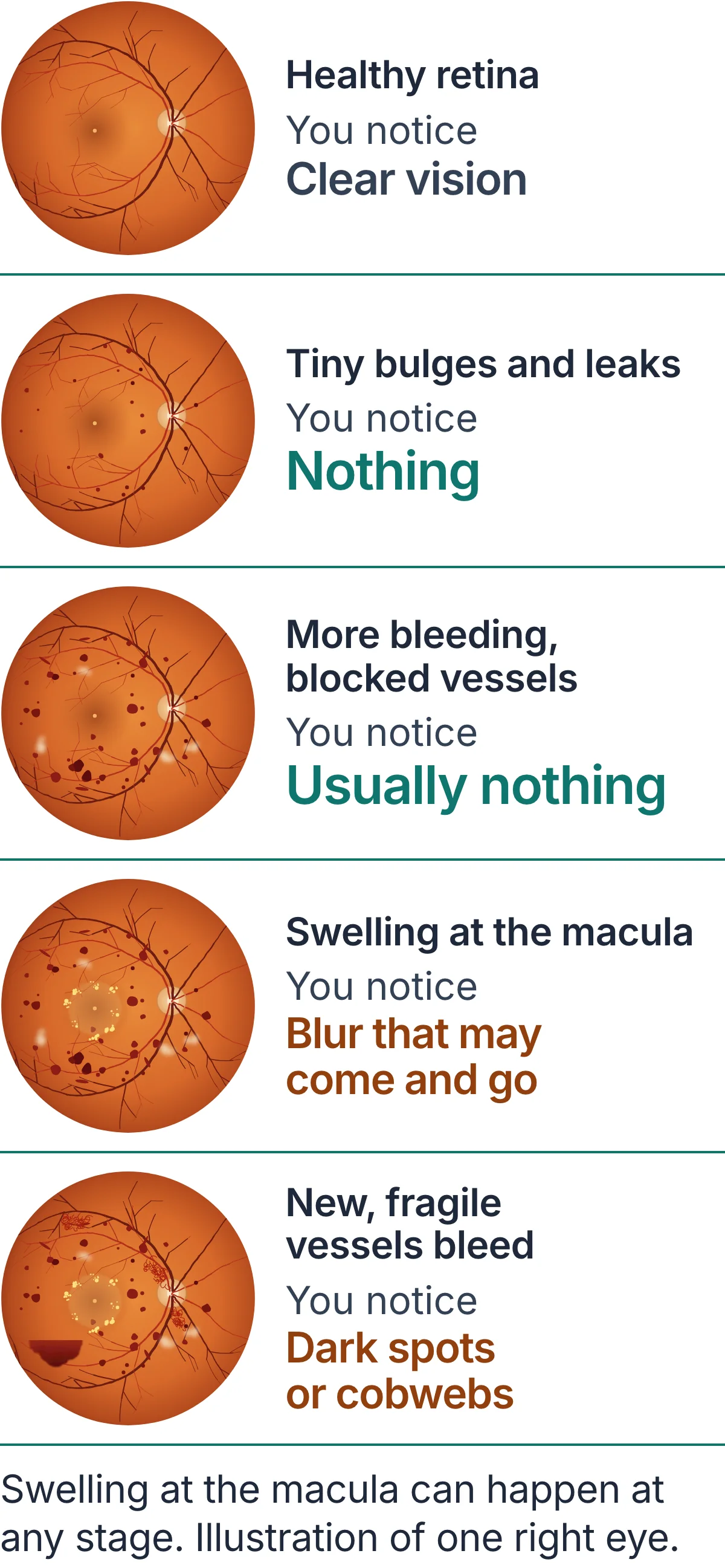
The walls of tiny vessels weaken first, forming little bulges called microaneurysms that can leak a bit of fluid or blood. Doctors call this non-proliferative retinopathy. You’d probably have no way of knowing it’s there.
As more vessels close, parts of the retina get less blood. This can still be silent, because the macula, the small central area you use to read and recognize faces, may not be affected yet. You can read the bottom line of the chart and still have retinopathy.
When leaking vessels flood the macula, central vision blurs. This is diabetic macular edema, which about 1 in 15 people with diabetes will develop over time, and it can happen at any stage.
Later comes new vessel growth, called proliferative retinopathy. The retina tries to make up for blocked vessels by growing new ones, but they’re fragile and bleed easily into the gel that fills the eye. They can also leave scars that pull the retina away from the back of the eye. This stage needs a retina specialist.
Which diabetic retinopathy symptoms need a call today?
Call the office that’s open that day:
- Monday or Thursday, Pasco: (509) 543-7953
- Tuesday or Wednesday, Hermiston: (541) 567-5283
- Friday, Sunnyside: (509) 839-4575
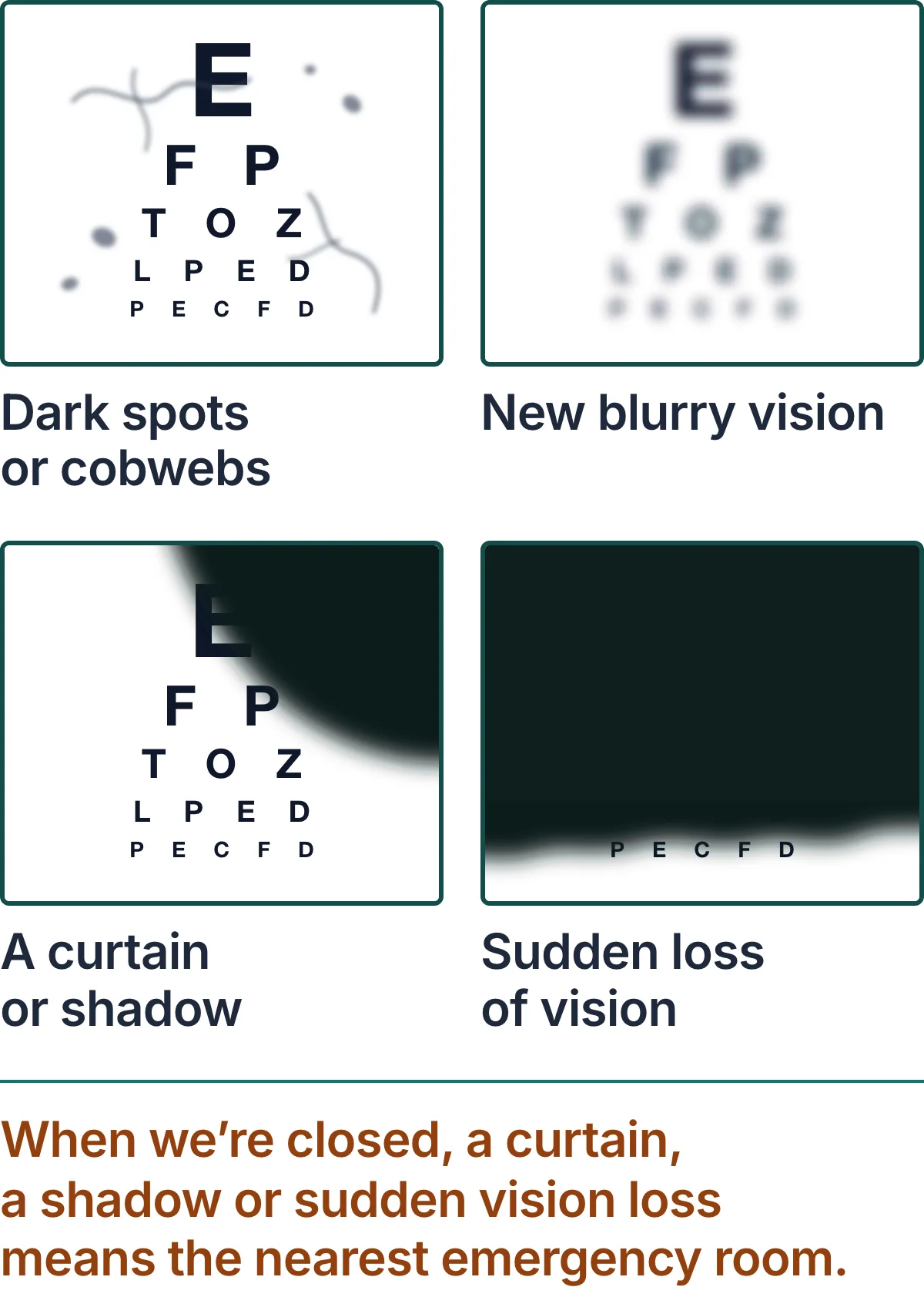
If you see a curtain or shadow across your vision, or your vision has dropped, and our offices are closed (evenings, Saturday and Sunday), don’t wait for us to open. Go to the nearest emergency room. Call 911 if vision loss comes with weakness, numbness, confusion or trouble speaking. For new floaters or flashes with no loss of vision, call us when we open, say what you’re seeing, and we’ll get you in. Our pages on eye emergencies and floaters and flashes have more.
Once symptoms do appear, the American Academy of Ophthalmology lists more floaters, blurry vision, vision that swings between blurry and clear, dark or blank areas, poor night vision, faded colors and vision loss.
Dark spots or streaks like cobwebs can mean blood in the gel of the eye. They sometimes clear on their own, and that isn’t a reason to wait. Without treatment, the bleeding can come back or get worse, and scars can form.
Blood sugar swings can also blur your vision for a while without any retinopathy, but you can’t tell the two apart from the outside. If something changes, call.
Who is most at risk?
Anyone with type 1 or type 2 diabetes can get diabetic retinopathy. The longer you’ve had diabetes, the higher the risk, and more than half of people with diabetes will develop it over time. High blood pressure and high cholesterol add to that risk.
Pregnancy raises the risk if you already have diabetes. The American Diabetes Association recommends an exam before pregnancy and in the first trimester, and sometimes every trimester. If you’re already pregnant, book now.
Diabetes raises other eye risks as well. It makes cataracts 2 to 5 times more likely and nearly doubles the risk of open-angle glaucoma. A yearly comprehensive eye exam looks for those too.
How often do you need a dilated eye exam?
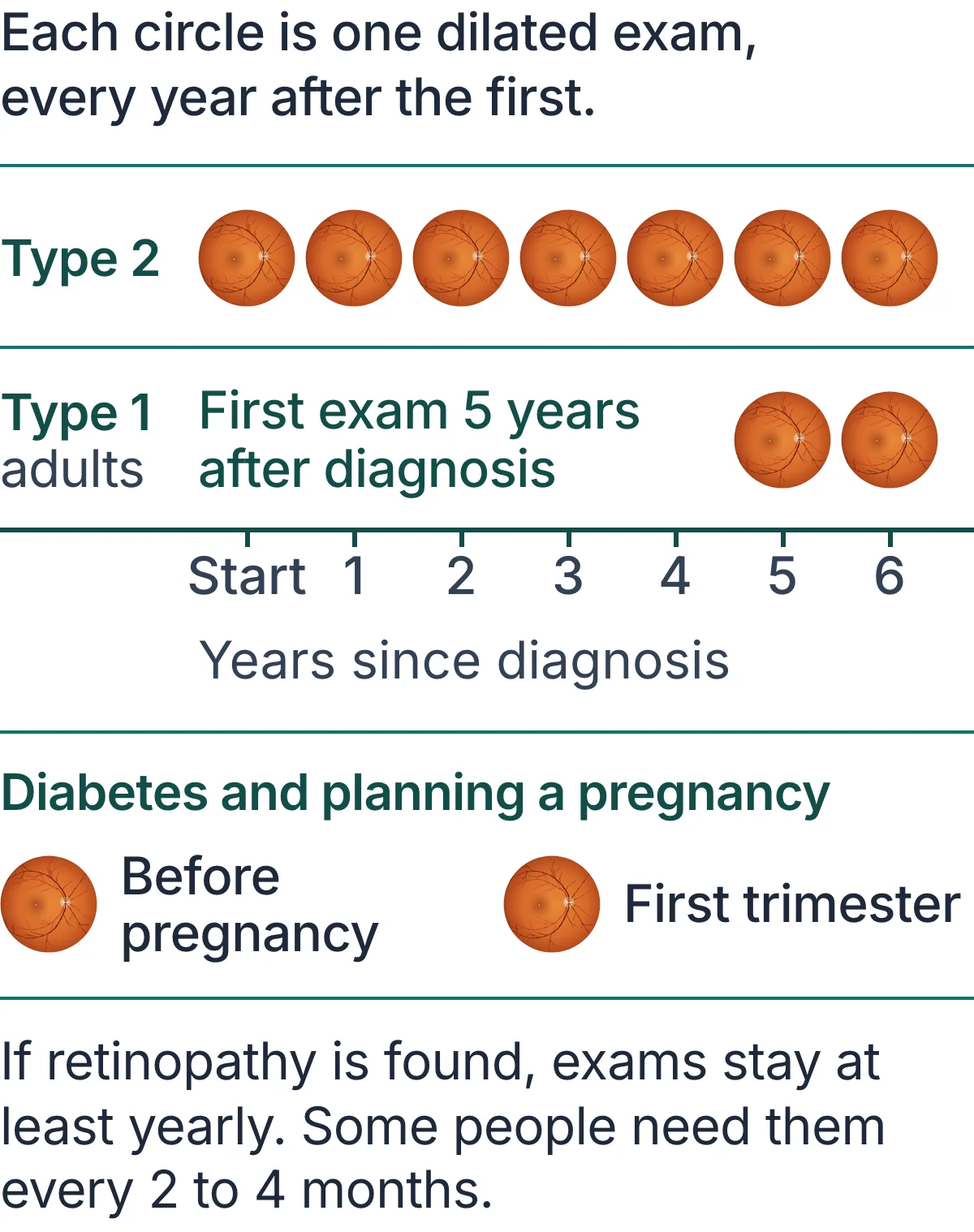
The National Eye Institute recommends a dilated exam at least once a year for everyone with diabetes. The American Diabetes Association’s 2026 standards set when the first one falls due. With type 2, it’s at diagnosis, because blood sugar may have been high for years before anyone knew. Adults with type 1 should have it 5 years after diagnosis.
After one or more normal exams, with blood sugar in your goal range, the ADA says every 1 to 2 years may be considered. Make that call with your eye doctor. In that same survey, only about 63 percent of adults with diabetes had been seen in the past 12 months.
What happens at a diabetic eye exam?
Drops widen your pupils so our doctors can see the retina, the optic nerve and the vessels. We also photograph the retina with Optomap, which gives us a record to compare year to year. At Pasco and Hermiston, an OCT scan shows the layers under the surface, where swelling from diabetes starts. Sunnyside’s imaging is on the Optomap Daytona.
If your doctor referred you, a report goes back to that office for your diabetes record. Dilation can blur your vision for a few hours, so bring sunglasses or someone to drive. You can read more on our diabetic eye exam page. Rabin cone contrast testing is a separate appointment, booked by phone, that gives a number we can compare from year to year.
What can slow it down?
In the Diabetes Control and Complications Trial, intensive treatment of type 1 diabetes cut the risk of developing retinopathy by 76 percent in people who had none, and slowed it by 54 percent in people with mild retinopathy. It also raised severe low blood sugar two- to threefold, which is why changes belong with your diabetes doctor.
In the UK Prospective Diabetes Study, people with type 2 diabetes and high blood pressure who had tighter blood pressure control were 34 percent less likely to see their retinopathy worsen by two steps on the grading scale over nine years.
Set your goals for blood sugar and blood pressure with the doctor who manages your diabetes. Our doctors can tell you what the retina shows, and that picture is often useful at your next medical visit.
What if retinopathy is found?
Early changes are usually watched closely, with more frequent exams and attention to blood sugar. If you need treatment such as injections, laser or surgery, our doctors refer you to a retina specialist and coordinate your care.
The National Eye Institute says early detection, timely treatment and follow-up together can cut the risk of severe vision loss by 95 percent.
Does insurance cover a diabetic eye exam?
Medicare Part B covers an eye exam for diabetic retinopathy once a year if you have diabetes. After the deductible, you usually pay 20 percent of the Medicare-approved amount. Other plans vary, so check our insurance page or call and we’ll look up your benefits. Because this is care for a medical condition, it may be handled as a medical eye exam and not a routine vision visit.
Common questions
Can I have diabetic retinopathy with 20/20 vision?
Yes. Early changes can leave the center of the retina alone, so you can see the chart perfectly well. A dilated exam finds what a vision test can’t.
Does diabetic retinopathy hurt?
Usually not. The early stages cause no symptoms at all, and pain isn’t how it tends to show itself. Any eye pain still deserves a call.
Can diabetic retinopathy go away?
Not on its own. Treatment can stop your vision from getting worse, and injections can sometimes slow or reverse the disease, but vision that’s already lost doesn’t always come back.
If my A1C is good, do I still need an eye exam?
Yes. Good control lowers your risk, but it doesn’t remove it, and your retina can’t be judged from a lab result. Ask our doctors how often you should come in.
Can I walk in for a diabetic eye exam?
Yes, on clinic days when the schedule allows. You don’t need to wait for symptoms, and calling ahead helps us get you in.
No diabetic retinopathy symptoms? Book your yearly exam anyway
Every office has Optomap imaging and Spanish interpreters, and all three are open 9:00 AM to 5:30 PM on their clinic days. Pasco is about 14 minutes from Kennewick and 13 from Richland. If you haven’t had your eyes dilated in the past year, this is a good month to do it.
- Pasco, Monday and Thursday: 4820 N Rd 68, inside Walmart, (509) 543-7953
- Sunnyside, Friday: 2675 E Lincoln Ave, inside Walmart, (509) 839-4575
- Hermiston, Tuesday and Wednesday: 1350 N 1st St, inside Walmart, (541) 567-5283
